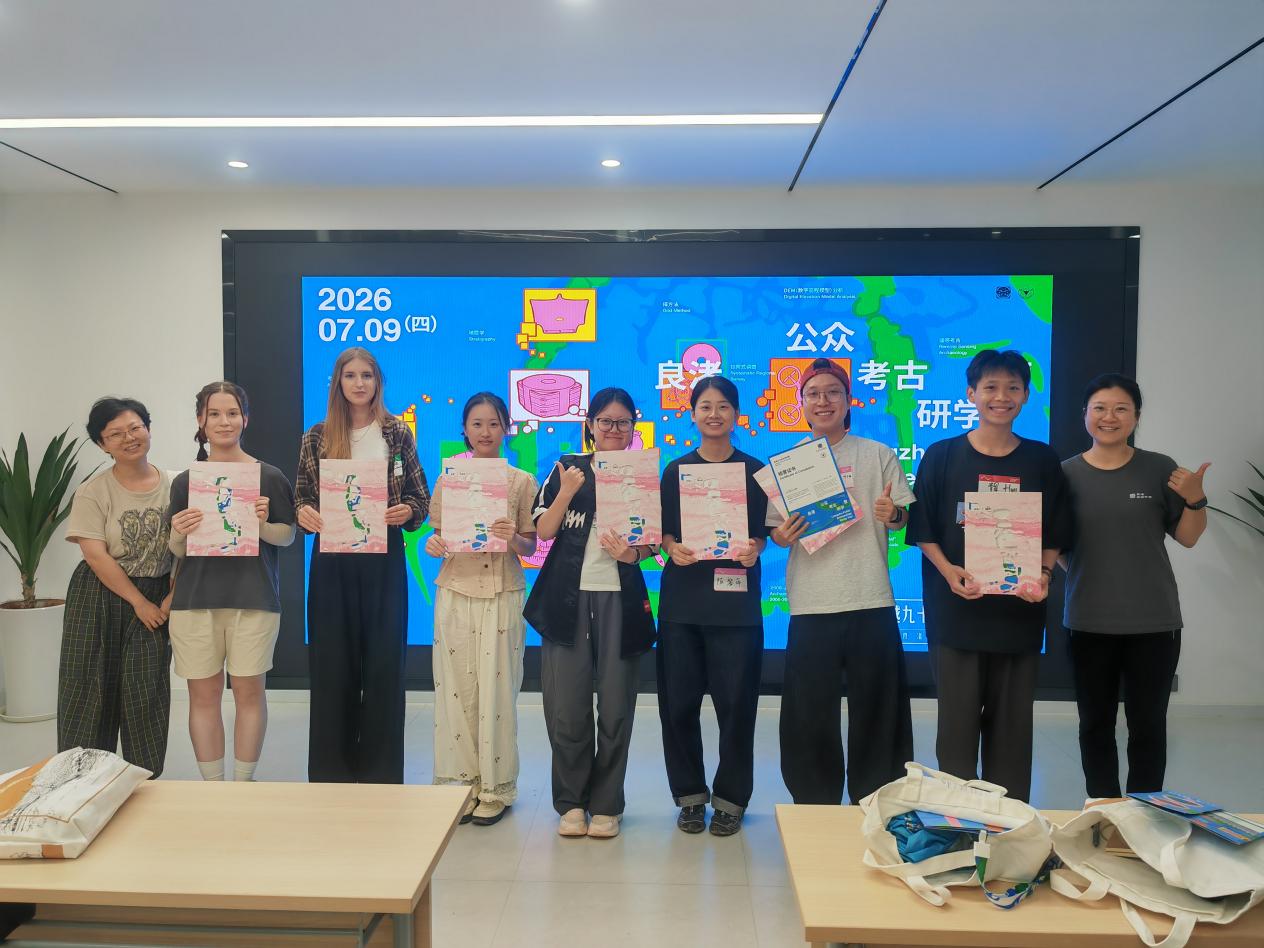
To mark the seventh Hangzhou Liangzhu Day and the 90th anniversary of archaeological work at Liangzhu, the Liangzhu Public Archaeology Study Camp—jointly organized by the Hangzhou Liangzhu Archaeological Site Management Committee and the School of Art and Archaeology at Zhejiang University—got underway. Six international students from ZJSU joined young people from multiple countries at the Liangzhu Ancient City site, embarking on a study tour guided throughout by archaeology experts. They completed a full learning loop—knowledge briefing, field study, hands-on practice, and group presentations—covering 90 years of Liangzhu archaeology in a single day. Through the eyes of youth, they gained an understanding of early Chinese civilization, built bridges of cross-cultural dialogue, and helped the world hear the story of Liangzhu.
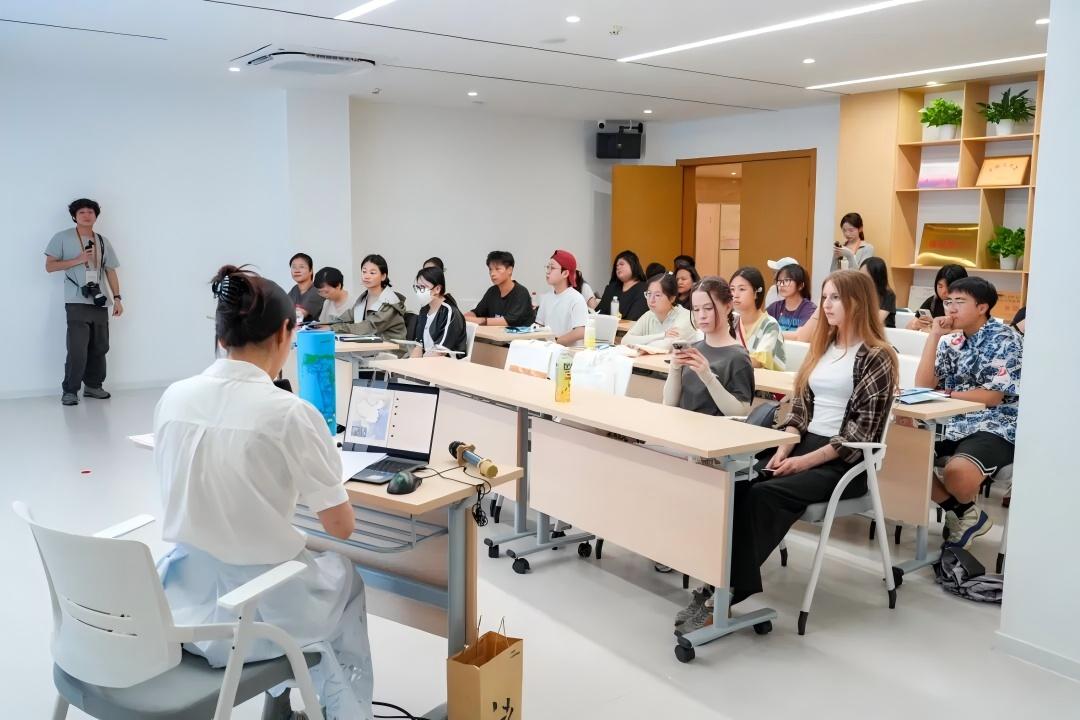
Icebreakers and Introduction: First Encounter with Liangzhu, Reading the Foundations of a Civilization
In the opening session, videos and a professional slide deck broke down the outstanding universal value of the Liangzhu Ancient City World Heritage property, giving the young participants a conceptual framework for understanding it as an “early regional state.” The international students were randomly grouped, given study kits, and brought together through lively icebreaker games that crossed national boundaries—young people of diverse skin tones and mother tongues quickly formed teams and set off on a daylong journey of discovery, brimming with curiosity.
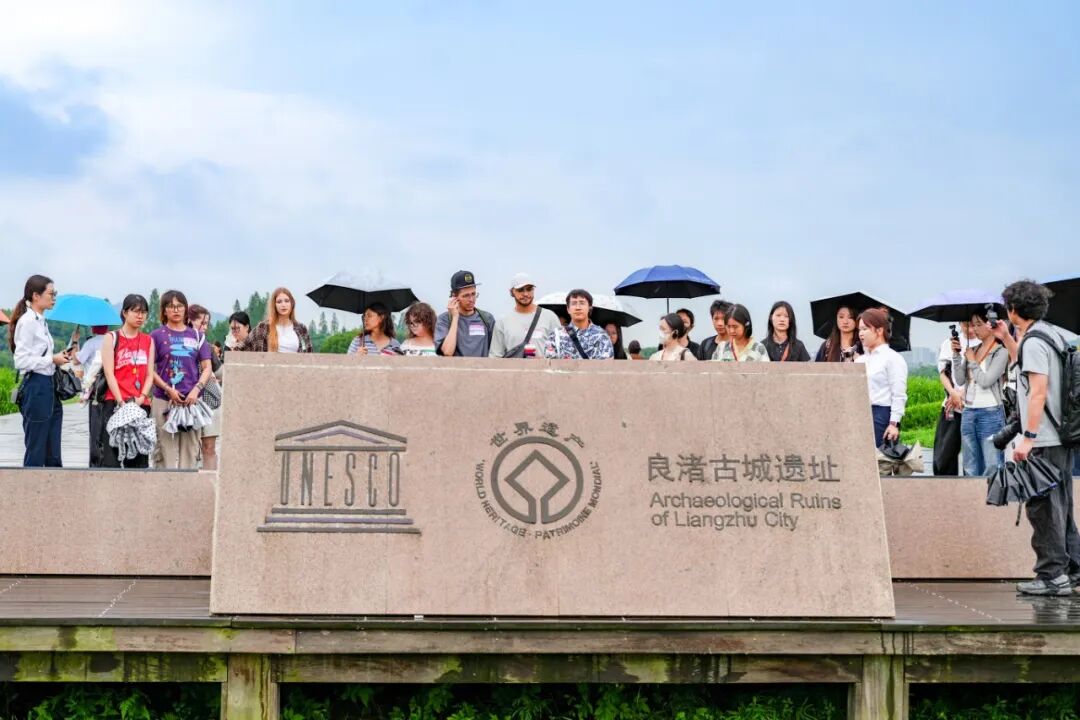
Climbing Mojiaoshan: A Bird’s-Eye View of a 5,000-Year-Old Capital
The first stop was Mojiaoshan Terrace, the political and spiritual heart of Liangzhu. Standing on the elevated ground and looking out over the entire ancient city—guided by a bronze model of the settlement—teachers and students together analyzed the triple, concentric layout of palace area, inner city, and outer city. The rammed-earth foundations and regular city walls offered striking evidence of the sophisticated social organization and powerful labor mobilization that existed 5,000 years ago. The international students stopped to take notes, marveling at the city-planning ingenuity of these prehistoric ancestors.
Entering the Fanshan Royal Tombs: A Dialogue Between Ancient and Modern Archaeological Paradigms
Inside the Fanshan conservation shelter, reconstructed displays of 11 high-ranking tombs lay in quiet array, with ritual jade artifacts carved with the deity-animal mask motif arranged in orderly positions—a clear window into Liangzhu’s unified belief system and its rigid ritual hierarchy. On site, archaeology experts compared two generations of field practice: from the traditional hand-trowel excavations that began in 1986 to today’s integrated “air-sky-ground-digital” scientific archaeology. Drone modeling and three-dimensional digital reconstructions were shown side by side, letting the students see directly how technology is reshaping archaeological research. On an immersive large screen at the workstation, the full panorama of palaces, dams, and the ancient city’s rivers and mountains unfolded, bringing the Liangzhu of 5,000 years ago within reach.
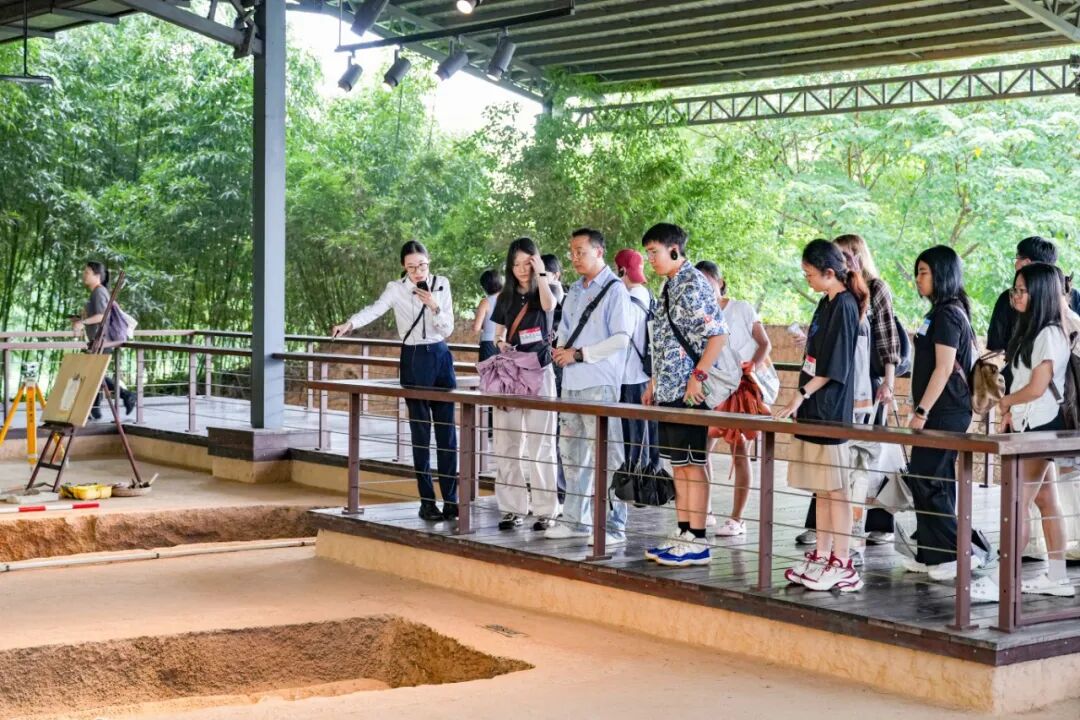
Walking the Ancient City Wall: Tracing the Full Territory of an Ancient State Capital
Stepping onto the ancient city wall, confirmed through excavations in 2006, the teachers recounted how surveyors once used probing stones and digital elevation mapping to close the loop of the city’s perimeter. Together with the massive outer hydraulic system, these features formed a mature and complete early-state urban complex. Walking along the 5,000-year-old rammed-earth wall, the international students gained a tangible understanding of the full civilization architecture of Liangzhu as a sophisticated ancient state.
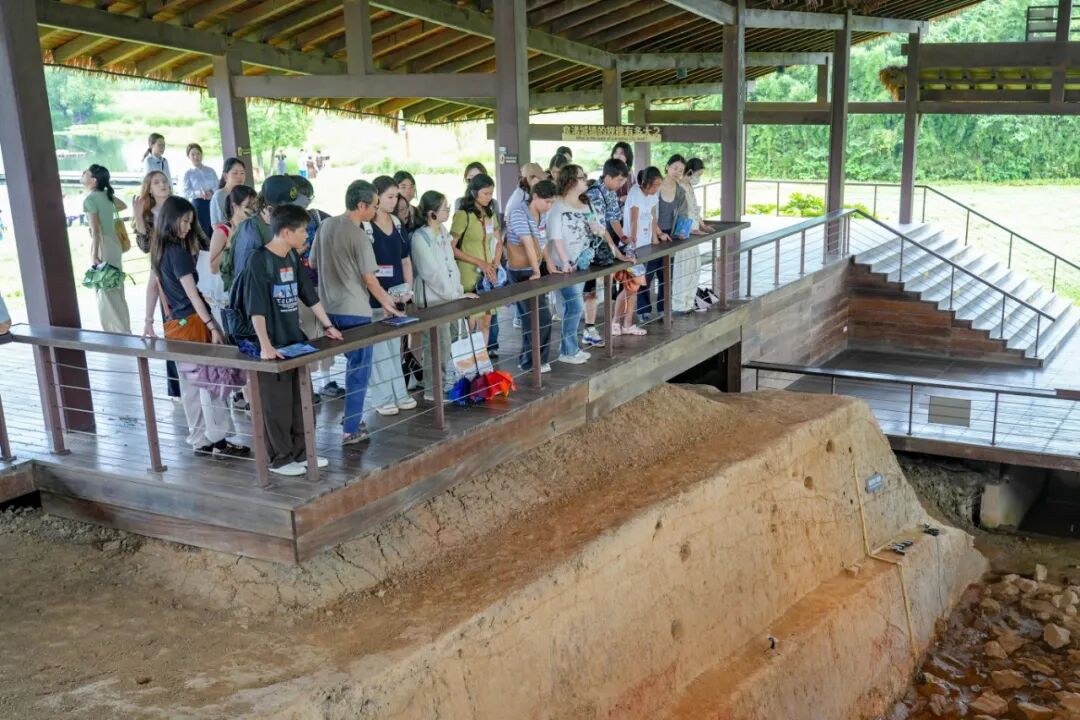
Hands-On Learning: Games and Technology Unlock the Code of Civilization
“In Search of the King Cong”: A Live-Action Deduction Game
After a midday break, the young people split into groups for a ritual jade deduction challenge. A 10-by-10 grid recreated the distribution of artifacts from the royal tombs, and participants drew on archaeological typology and spatial distribution patterns to reason out the burial logic of jade cong, bi, and yue. Through the board-game-style interaction, they absorbed Liangzhu’s jade ritual system, turning dry archaeological knowledge into something vivid and tangible.
Immersive Experience in the 3D Technology Lab
In the afternoon, the group visited the laboratory at the Liangzhu Archaeology Conservation Center. Multidisciplinary methods—radiocarbon dating, isotope analysis, and more—were explained one by one, addressing core questions such as the origins of Liangzhu’s inhabitants and the spread of rice-farming civilization. Putting on red-and-blue 3D glasses, the students watched old satellite imagery combine into a three-dimensional terrain model of the ancient city, with mountains, high ground, and waterways rendered in depth. In an instant, they grasped the planning logic behind the ancestors’ choice to build their capital on elevated ground. Everyone also tried their hand at polishing ancient-style jade artifacts, touching the craftsmanship of a 5,000-year-old artisan.
Closing Review: Tracing 90 Years of Archaeological Progress
The camp concluded with a review of what had been learned. Each group used a magnetic board to build an “evolution tree” of Liangzhu archaeological methods, mapping key milestones—Shi Xingeng’s discovery of black pottery shards in 1936, the excavation of the Fanshan royal tombs, the confirmation of the city wall, and the advent of digital archaeology—onto corresponding techniques such as stratigraphy, drone surveying, and radiocarbon dating. In this way, they traced 90 years of archaeological development with their own hands and gained a deep understanding of how multidisciplinary integration has driven the field forward. Each group then presented on one of three themes: “How Archaeological Technology Changes Our Understanding of Civilization,” “The Global Value of Liangzhu Civilization,” and “Protecting and Passing On World Heritage.”
Voices of Youth: From Bystanders to Ambassadors of Civilization
Though only a single day, the study tour strung together 90 years of archaeological endeavor and a 5,000-year river of civilization. Walking among Mojiaoshan, Fanshan, and the ancient city wall, ZJSU’s international students were no longer mere sightseers at the site—they became witnesses and messengers of Liangzhu civilization.
Civilizations of every background met, conversed, and resonated here. The young people measured the heritage on foot, bridged divides through exchange, and carried Liangzhu’s distinctive urban, hydraulic, and jade-ritual culture in their hearts. In the days ahead, they will take what they saw and felt today back to their own countries, carrying the story of Liangzhu—the evidence of China’s 5,000-year civilization—so that this ancient Eastern heritage continues to live on among young people around the world.
A 5,000-year civilization runs unbroken, and cross-cultural exchange never rests. Using the study tour as a medium, ZJSU’s international students have built a cultural bridge between China and the world, letting the voice of Liangzhu echo across the globe.