
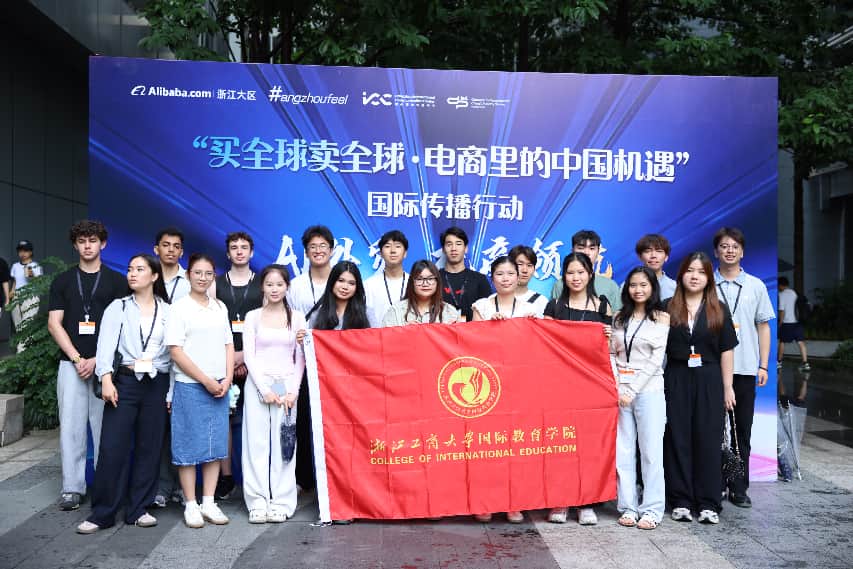
Recently, the “Buy Global, Sell Global: China’s Opportunities in E-commerce” international communications initiative—part of the “Cross-Border E-commerce Training Camp” series—officially launched at Alibaba’s Binjiang campus. The event was jointly organized by the Hangzhou International Communications Center and Alibaba Zhejiang Region.
Under the theme “AI in Foreign Trade, Led by Hangzhou Commerce,” the event brought together industry experts, leading merchants, numerous foreign-trade practitioners, and international students from Zhejiang Gongshang University to explore new pathways for cross-border e-commerce in the age of AI and to share with the world Hangzhou’s digital-economy vitality and open opportunities.
AI Reshaping Foreign Trade: A Leap from B2B to A2A
Shu Wenjian, Alibaba’s regional manager for Hangzhou, took the floor first, giving a live demonstration of Accio Work, Alibaba’s enterprise-grade AI agent platform. With simple instructions, the AI can autonomously carry out an entire chain of tasks—market research, product selection analysis, product listing, and smart customer reception. One person, aided by AI, can do business in more than two hundred countries and regions worldwide.
Hands-On Experience: From Zero to Ten-Million-Yuan Revenue
Zhang Qingwei, CEO of Hangzhou Polygon Pet Products Co., Ltd., spoke on the theme “Putting the User at the Center, Growing Small B2B Clients into Big Ones,” sharing the full path from solo entrepreneurship to building a systematic team. On client positioning, he laid out a “do only four things” principle: focus on one country or region, one product category, one customer segment, and one matching type of supplier. “Don’t want everything at once,” he repeated. “Niche markets are becoming ever more specialized.”
Platform Empowerment: Paving the Way for New Merchants Going Global
Zheng Junfeng, a senior key account manager at Alibaba, systematically explained the growth path and service support system for new merchants. He pointed out the core difference between B2B and B2C: B2C is business with strangers, requiring overseas warehouses and ready stock, and orders tend to be one-off; B2B, by contrast, is business with long-term overseas partners—customers are a merchant’s core asset and carry lasting repeat-purchase value.
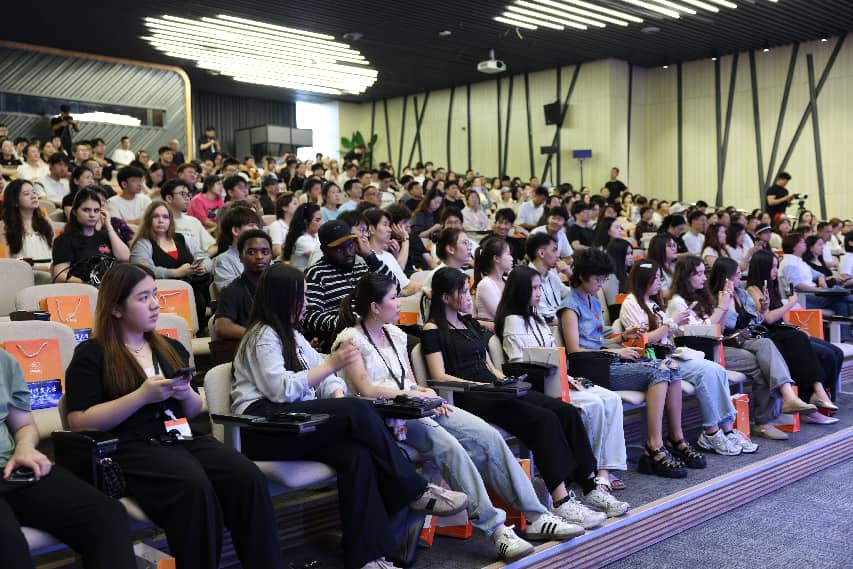
Student Takeaways:
Utama Kellen Irin (Zhu Jinwei), Indonesia
The level of integration and efficiency in China’s cross-border e-commerce far surpasses that of other countries. As an e-commerce major at ZJSU, I came here to master the whole system—from payment to logistics, from live streaming to social marketing—so that I can go home and make cross-border business in Indonesia more efficient.
Alpsbek Assanali (A Sang), Kazakhstan
Kazakhstan’s Kaspi Bank and Alipay have deep cooperation. Chinese tourists can use Alipay in Kazakhstan, and we can use Alipay through Kaspi. This kind of payment interconnection means cross-border trade is no longer just selling goods—it is about connecting entire ecosystems.
Dermenzhi Pavel (Pan Yong), Russia
In the past, running a business required hundreds of people, each with a defined role. Now, if you have enough self-motivation, one person with the right AI tools can handle every step—searching, acquiring customers, replying to clients, and more. AI has freed us in a big way.This training camp was more than a transfer of knowledge; it was a city narrative rooted in Hangzhou’s industrial strength.
These international students, from countries jointly building the Belt and Road Initiative, did more than witness the technological wave of AI reshaping foreign trade at the Alibaba Binjiang training camp—they clearly found their own “coordinates in China.” For them, “China’s opportunity” is a concrete path now being written into their life plans.